Quality products make an important contribution to long-term revenue and profitability. Cost-effective and customizable Thiamphenicol 15318-45-3 in stock
1.What is the Thiamphenicol ?
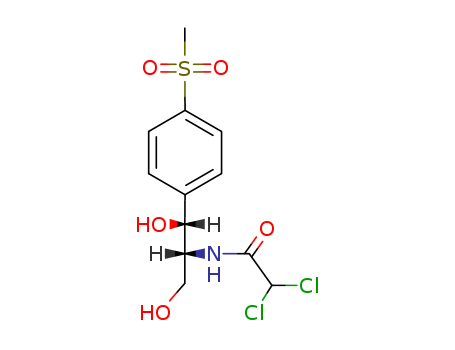
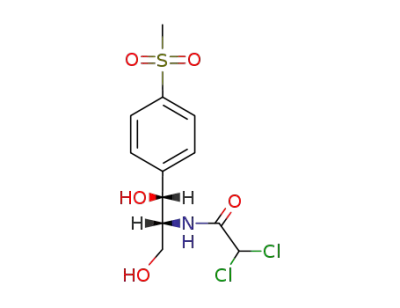
Thiamphenicol is a semi-synthetic chloramphenicol prepared by total synthesis from thiophenol in which the nitro moiety of chloramphenicol is replaced by a methylsulphone, first synthesised at Sterling Winthrop in 1952. Thiamphenicol is a broad spectrum antibiotic with good activity against Gram negative and anaerobic bacteria. Thiamphenicol acts by binding to the 23S sub-unit of the 50S ribosome inhibiting protein synthesis. Thiamphenicol has been extensively studied with over 800 literature citations.
-
-
116-54-1
dichloroacetic acid methyl ester
-
-
51458-28-7
(1R,2R)-2-amino-1-<4-(methylsulphonyl)phenyl>-1,3-propanediol
-
-
15318-45-3,90-91-5
thiamphenicol
Conditions
| Conditions |
Yield |
|
With
triethylamine;
In
methanol;
at 30 ℃;
for 0.166667h;
Temperature;
|
99%
|
|
With
triethylamine;
In
methanol;
at 30 ℃;
for 0.166667h;
|
96%
|
|
With
triethylamine;
In
methanol;
at 30 ℃;
for 8h;
Inert atmosphere;
|
95%
|
|
In
methanol;
at 23 - 40 ℃;
for 16h;
Inert atmosphere;
|
92%
|
|
With
ethanol;
|
|
-
-
3018-12-0
dichloroacetonitrile
-
-
36983-12-7
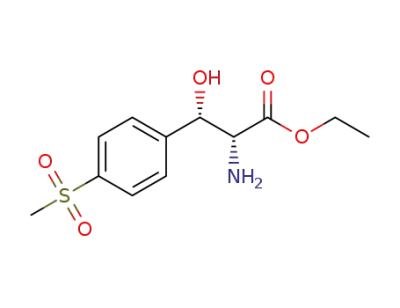
D-threo-p-methylsulfonylphenylserine ethyl ester
-
-
15318-45-3,90-91-5
thiamphenicol
Conditions
| Conditions |
Yield |
|
D-threo-p-methylsulfonylphenylserine ethyl ester;
With
potassium borohydride;
In
methanol;
at 40 ℃;
dichloroacetonitrile;
With
acetic acid;
In
methanol;
at 65 ℃;
pH=7;
With
hydrogenchloride; water;
In
methanol;
at 85 ℃;
for 2.5h;
|
79.4%
|
2.What is the CAS number for Thiamphenicol ?
The CAS number of Thiamphenicol is 15318-45-3.
More information of Thiamphenicol 15318-45-3 are:
|
CAS Number
|
15318-45-3 |
|
Density
|
1.491 g/cm3 |
|
Melting Point
|
163-166 °C |
|
Boiling Point
|
695.9 °C at 760 mmHg |
|
Flash Point
|
374.7 °C |
|
Refractive Index
|
1.6000 (estimate) |
|
HS CODE
|
29414000 |
|
PSA
|
112.08000 |
|
LogP
|
1.87600 |
|
Pka
|
11.05±0.46(Predicted) |
3.What are another words for Thiamphenicol ?
Synonyms for Thiamphenicol 15318-45-3:Acetamide,2,2-dichloro-N-[2-hydroxy-1-(hydroxymethyl)-2-[4-(methylsulfonyl)phenyl]ethyl]-,[R-(R*,R*)]-;(Methylsulfonyl)chloramphenicol;8065CB;D-Thiocymetin;D-Thiophenicol;D-d-threo-2-Dichloroacetamido-1-(4-methylsulfonylphenyl)-1,3-propanediol;Dextrosulphenidol;NSC 522822;Thiocymetin;Thiophenicol;Win 5063-2;
4.What is the molecular formula of Thiamphenicol?
The chemical formula of Thiamphenicol is C12H15Cl2NO5S which containing 12 Carbon atoms,15 Hydrogen atoms,2 Chlorine atoms,1 Nitrogen atoms,5 Oxygen atoms and 1 Sulfur atoms,and the molecular weight of Thiamphenicol is 356.227.
5.What is Thiamphenicol (15318-45-3) used for?
Thiamphenicol is a broad-spectrum antibiotic chloramphenicol, which is more effective to the gram-negative bacteria than the gram-positive bacteria. At room temperature, it is a white to off-white crystalline powder or crystal, which can be quickly and completely absorped by oral adminstration, as well as it is excreted mainly in the prototype from the urine for metabolism. It is clinically applied for the treatment of respiratory, urinary tract, liver and gallbladder, typhoid and other intestinal surgery, gynecology and ENT infections. Especially in the mild infections it is more effective. It has the similar chemical structure with the chloramphenicol. Its methyl sulfone substituted the nitro of chloramphenicol, which reduced its toxicity, and in vivo its antibacterial activity is 2.5-5 times stronger than chloramphenicol. For gram-positive bacteria, such as streptococcus pneumoniae and hemolytic streptococcus, it has very strong antibacterial effect, while for gram-negative bacteria, such as Neisseria gonorrhoeae, meningococcus, lung Bacteroides, E. coli, Vibrio cholerae, Shigella and influenza bacillus, it also has strong antibacterial effect. For anaerobic bacteria, Rickettsia and amoeba, it has antibacterial effect in some extent. It has the same antimicrobial mechanism with chloramphenicol, which mainly inhibits the synthesis of bacterial protein. This drug is absorped quickly by oral administration, which reaches peak blood concentration within two hours. Its half-life is 5 hours, that is more longer than chloramphenicol. The bacteria have complete cross resistance to it and chloramphenicol, while the bacteria have some cross-resistance phenomenon to it and tetracycline.
Thiamphenicol also has strong immunosuppressive effects, which is an excellent immunosuppressant. Its mechanism of action have significantly different with other immunosuppressive agents. The immunosuppressive effect is several times higher than the chloramphenicol. It can be as the effective extender for transplantation reaction and surgically allogeneic transplantation.
InChI:InChI=1/C12H14Cl2N2O7S/c1-24(21,22)23-6-9(15-12(18)11(13)14)10(17)7-2-4-8(5-3-7)16(19)20/h2-5,9-11,17H,6H2,1H3,(H,15,18)/t9-,10-/m1/s1
Relevant articles related to Thiamphenicol:
|
Article
|
Source
|
|
An Efficient Stereoselective Total Synthesis of All Stereoisomers of the Antibiotic Thiamphenicol through Ruthenium-Catalyzed Asymmetric Reduction by Dynamic Kinetic Resolution
|
Perez, Marc,Echeverria, Pierre-Georges,Martinez-Arripe, Elsa,Ez Zoubir, Mehdi,Touati, Ridha,Zhang, Zhaoguo,Genet, Jean-Pierre,Phansavath, Phannarath,Ayad, Tahar,Ratovelomanana-Vidal, Virginie
, p. 5949 - 5958 (2015)
|
|
Catalytic Syn-Selective Nitroaldol Approach to Amphenicol Antibiotics: Evolution of a Unified Asymmetric Synthesis of (-)-Chloramphenicol, (-)-Azidamphenicol, (+)-Thiamphenicol, and (+)-Florfenicol
|
Chen, Fener,Cheng, Dang,Huang, Huashan,Jiang, Meifen,Liu, Minjie,Qu, Hongmin,Xia, Yingqi,Xiong, Tong,Zhang, Yan
, p. 11557 - 11570 (2021/09/02)
|
6.Buy Thiamphenicol with the best price .
Hebei Zhaohe Chemical Technology Co., Ltd. is a quality supplier of Thiamphenicol. Our main goal is customer satisfaction. Contact us to negotiate the best price for your business on Thiamphenicol 15318-45-3.