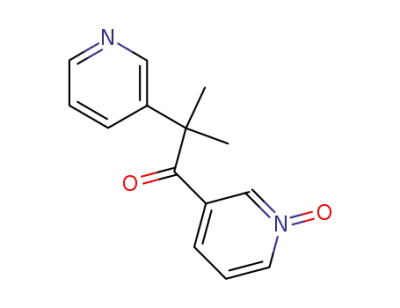
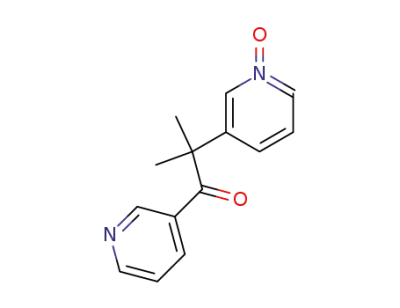
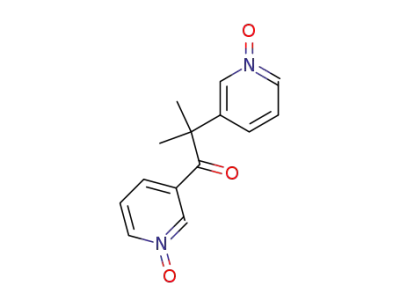
|
Manufacturing Process
|
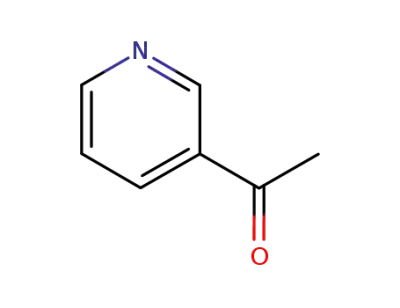
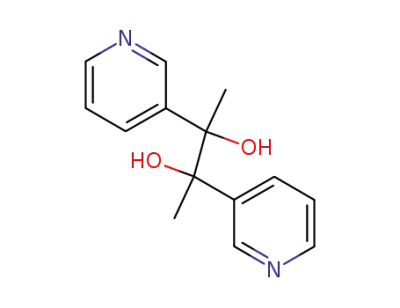
According to US Patent 2,966,493, the 2,3-bis-(3-pyridyl)-2,3-butanediol used
as the starting material may be prepared as follows. A solution of 1,430 g of
3-acetyl-pyridine in 7,042 ml of a 1 N aqueous solution of potassium
hydroxide is placed into a cathode chamber containing a mercury cathode with
a surface of 353 cm2 and is separated from an anode chamber by an Alundum
membrane. As anode a platinum wire is used and the anolyte consists of a 1
N solution of aqueous potassium hydroxide which is replenished from time to
time.The electrolysis is carried out at a reference potential of -2.4 volts vs a
standard calomel electrode. An initial current density of 0.0403 amp/cm2 is
obtained which drops to 0.0195 amp/cm2 at the end of the reduction, which is
carried on over a period of 1,682 minutes at 15° to 20°C. The catholyte is
filtered, the solid material is washed with water and dried. 430 g of the 2,3-
bis-(3-pyridyl)-butane-2,3-diol is recrystallized from water, MP 244° to 245°C.A mixture of 3.43 g of 2,3-bis-(3-pyridyl)-2,3-butane-diol and 25 ml of
concentrated sulfuric acid is heated to 76°C and kept at that temperature for
7? hours. It is then poured on ice, neutralized with 50% aqueous solution of
sodium hydroxide and the pH is adjusted to 8 with solid sodium carbonate.
The aqueous solution is three times extracted with ethyl acetate, the
separated organic layer dried over sodium sulfate and evaporated to dryness.The residue is distilled and 1.86 g of viscous, colorless oil is obtained which is
purified by distillation. BP 140° to 160°C/0.07 mm. The infrared spectrum
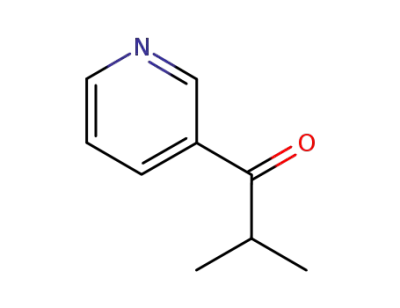
shows the presence of a mixture of two compounds, one containing a
conjugated, the other one an unconjugated carbonyl group, without the
presence of a compound containing a hydroxyl group; thus the rearrangement
has taken place.The resulting mixture does not crystalize and is converted into a mixture of
oximes by treatment of a solution of the mixture in 20 ml of ethanol with a
solution of 1.8 g of hydroxylamine sulfate in 3 ml of water. 1.8 g of sodium
acetate in 5 ml of water is added, and the mixture is refluxed for 5 hours,
then extracted with ethyl acetate, and the ethyl acetate solution is washed
with a saturated aqueous sodium chloride solution and dried over sodium
sulfate. After evaporating the solvent, the residue is triturated with warm
ether and 1.1 g of a crystalline oxime is obtained, MP 168° to 171°C.0.1 g of the resulting oxime is dissolved in 5 ml of 2 N aqueous sulfuric acid
and the mixture is refluxed for 3 hours and allowed to stand overnight. After
being rendered basic by adding a concentrated aqueous solution of sodium
hydroxide and adjusted to a pH of 8 with sodium carbonate, the mixture is
extracted 3 times with ethyl acetate; the organic layer is washed with water,
dried and evaporated. Upon distillation of the residue an oily product is
obtained, BP 130° to 160°C/0.3 mm. Infrared analysis shows the presence of
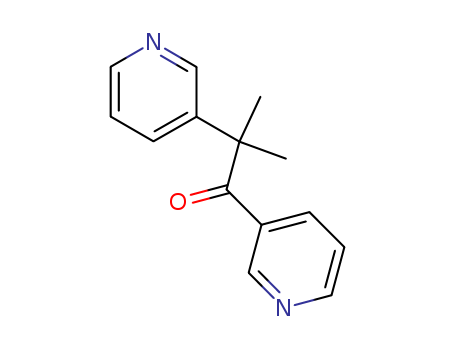
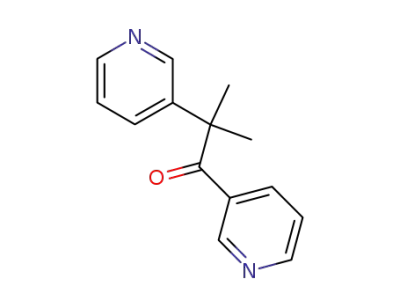
a uniform compound, containing a conjugated carbonyl group. The 2-methyl-
1,2-bis-(3-pyridyl)-propane-1-one crystallizes upon standing at room
temperature or by covering the oily distillate with pentane and cooling to -
80°C and filtering the oily crystals. It melts after recrystallization from a
mixture of ether, hexane and petroleum ether at 48° to 50°C. |
|
Side effects
|
Side effects associated with the use of metyrapone include
gastrointestinal distress, dizziness, headache, sedation,
and allergic rash. The drug should not be used in
cases of adrenocortical insufficiency or when hypersensitivity
reactions can be expected. When administered
to pregnant women during the second or third trimesters,
the drug may impair steroid biosynthesis in the
fetus. Because metyrapone is relatively nontoxic, it is
used in combination therapy with the more toxic aminoglutethimide
to reduce its dosage. |